1. Scenario
For AI product teams, algorithm engineering teams and innovation units: a standardised delivery framework from requirement insight, algorithm selection and data preparation to model development, engineering deployment and live operations. Built-in structured milestones, requirement groups, task trees with estimated workhours, test cases and document templates turn key gates — requirement sign-off, algorithm feasibility review, data audit, model acceptance and post-launch validation — into process checkpoints, so the team delivers to spec by following the sequence.
Suitable for
Solves
2. Demo Company
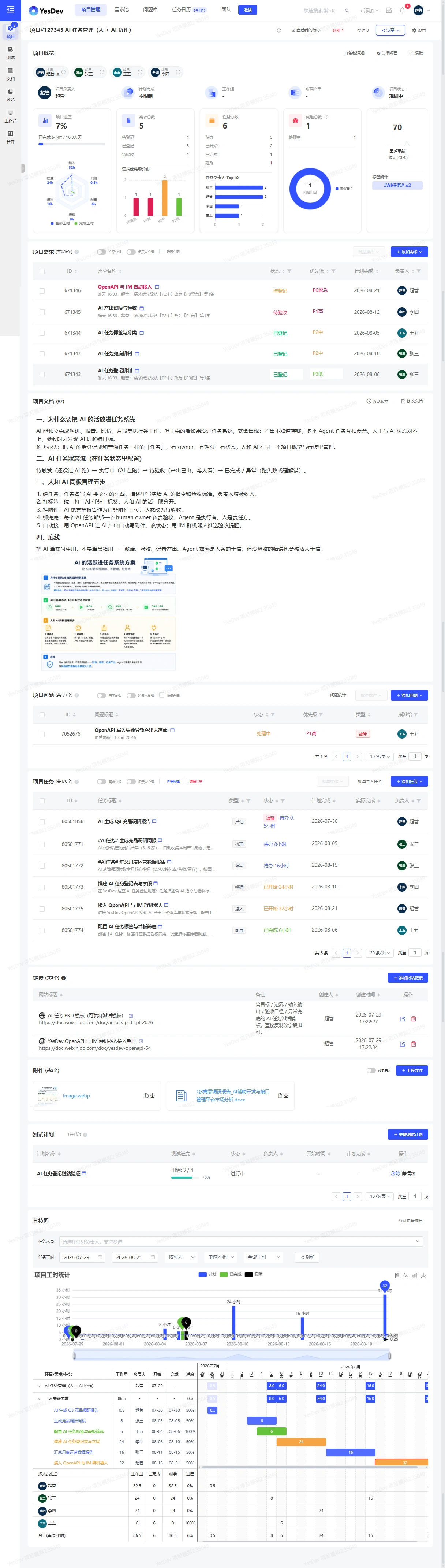
Template screenshotsClick to enlarge
3. Project Template
Pre-built tasks for the whole AI product development process, requirement groups, test cases, test plans, issue tracking, interface documents and project document links. Stages are split by milestone, tasks carry workhour estimation baselines and key gates act as process checkpoints, so it works directly as a scheduling and cost reference.
- 1Requirement insight and use-case definition
- 2Algorithm feasibility assessment
- 3Data preparation and labelling
- 4Model development and training
- 5Model acceptance and tuning
- 6Engineering deployment and integration
- 7Live operations and outcome validation
4. Custom Fields
| Field | Type |
|---|---|
| Task type | Status |
| Estimated workhours | Number |
| Model version | Text |
| Data version | Text |
| Owner | Person |
| Priority | Status |
5. Workflow Configuration
6. Default Document Templates
Once the template is enabled, the following document structure is generated automatically (one-click creation will be available later).
- Project overviewProject background / target scenario / delivery scope / contacts
- PRD (requirement document)Feature list / business flow / algorithm requirements / acceptance criteria
- Algorithm designModel selection / training plan / evaluation metrics / risk notes
- Data guidelinesData collection / cleaning / labelling rules / version management
- Test planUnit testing / model acceptance / integration testing / canary release
- Launch acceptance reportLaunch metrics / outcome validation / issue log / next steps