1. Scenario
For indie studios of 1-3 people: take a single app from idea to app store launch, covering requirement scoping, prototyping, core development, store listing materials, submission and post-launch iteration.
Suitable for
Indie developersSmall studiosTeams building apps part-time
Solves
Scattered, unstructured ideas: without clear positioning and boundaries, development keeps expandingUnclear requirement boundaries: a fuzzy MVP scope leads to feature creep and a delayed launchNo development rhythm: solo devs and small teams lack milestones and a daily cadenceStore material easily missed: screenshots, privacy policy and keywords are all required, and rejections are commonNo record of rejections: issues are scattered across email and IM, so the previous rejection reason is lost when resubmitting
2. Demo Company
Demo company
Yunyu Mobile App Studio (an indie studio of 1-3 people, example)
Demo project
Minimalist focus-timer app: idea to app store launch
Template screenshotsClick to enlarge
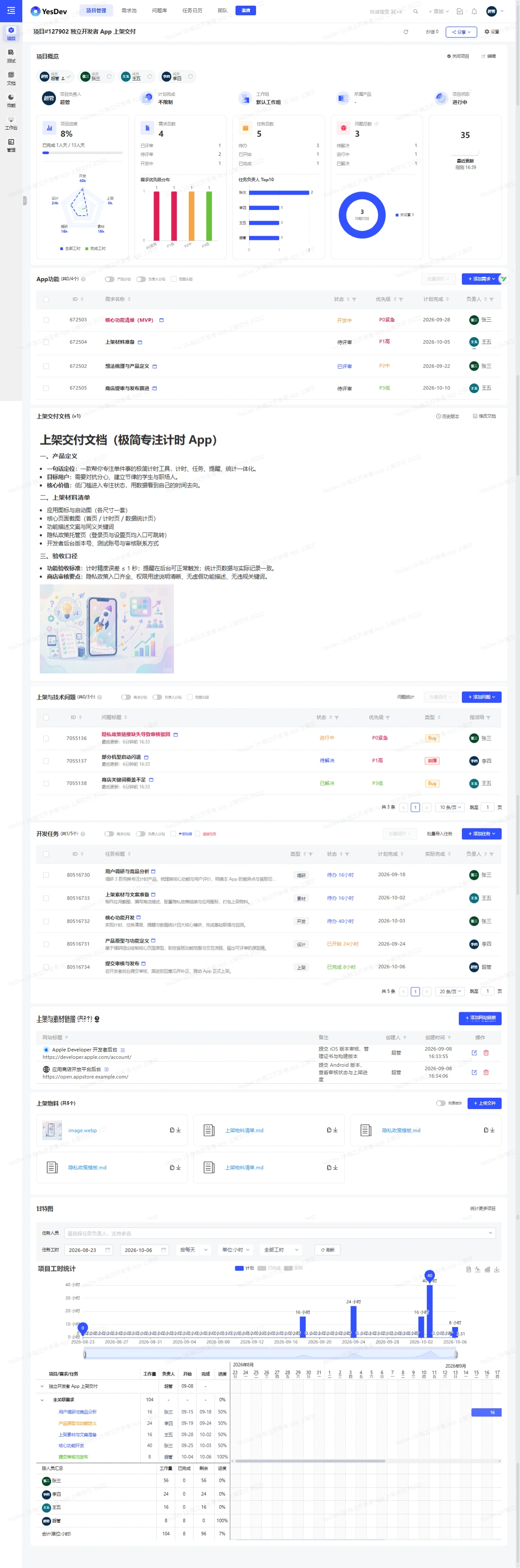
3. Project Template
Built for indie developers and small studios, the whole launch chain is split into six stages plus seven components — launch delivery document, app feature requirements, development tasks, launch and technical issues, store and asset links, store material and a Gantt chart — covering the complete loop from product definition to post-launch iteration.
Project stages
- 1Idea scoping and product definition
- 2Prototyping and feature design
- 3Core feature development
- 4Store listing material preparation
- 5Store submission and release
- 6Post-launch follow-up and iteration
4. Custom Fields
| Field | Type |
|---|---|
| App platform | Status |
| Store type | Status |
| Requirement source | Status |
5. Workflow Configuration
Status
To do→Started→Done→Delayed→Cancelled
6. Default Document Templates
Once the template is enabled, the following document structure is generated automatically (one-click creation will be available later).
- Launch delivery documentProduct definition / store listing material checklist / acceptance criteria (functional acceptance standards and store review points)